What is IoT architecture?

Why do you need a robust Internet of Things architecture?
Still, when talking about the Internet of Things, much attention is paid to its potential. News about what IoT will be able to do and how it will empower our lives keeps flooding in, but for many it may seem that these uplifting visions don’t translate into reality as fast as we wish they could. Nevertheless, the big change does happen, yet it happens in dribs and drabs rather than in giant leaps. The reason for this is quite simple, but it tends to stay out of the public eye: it is the inherent diversity of IoT systems that stifles the progress and often stands in the way to make all things connected.

As one of two presumably biggest challenges standing before IoT (the other being security), fragmentation is at the core of the Internet of Things because of the diverse nature of the Things that it aims to connect. Putting any IoT system to work requires harnessing all the resources, hardware, software, and systems, however varied they all may be, into one single framework to form an integrated, reliable, and cost-effective solution. In simple terms, every IoT deployment needs a rock-solid IoT architecture to be able to serve its designed purpose; the resulting efficiency and applicability of the system largely depends on the quality of the infrastructure developed.
IoT architecture building blocks
While every IoT system is different, the foundation for each Internet of Things architecture as well as its general data process flow is roughly the same. First of all, it consists of the Things, which are objects connected to the Internet which by means of their embedded sensors and actuators are able to sense the environment around them and gather information that is then passed on to IoT gateways. The next stage consists of IoT data acquisition systems and gateways that collect the great mass of unprocessed data, convert it into digital streams, filter and pre-process it so that it is ready for analysis. The third layer is represented by edge devices responsible for further processing and enhanced analysis of data. This layer is also where visualisation and machine learning technologies may step in. After that, the data is transferred to data centres which can be either cloud-based or installed locally. This is where the data is stored, managed and analysed in depth for actionable insights.
These are the four layers of IoT architecture described in detail:
 Data Flow

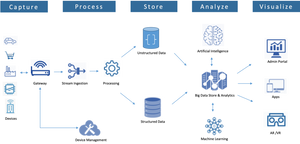

Things, sensors and controllers

As the basis for every IoT system, connected devices are responsible for providing the essence of the Internet of Things which is the data. To pick up physical parameters in the outside world or within the object itself, they need sensors. These can be either embedded in the devices themselves or implemented as standalone objects to measure and collect telemetry data. For an example, think of agricultural sensors whose task is to measure parameters such as air and soil temperature and humidity, soil pH levels or crop exposure to sunlight.
Another indispensable element of this layer are the actuators. Being in close collaboration with the sensors, they can transform the data generated by smart objects into physical action. Let’s imagine a smart watering system with all the necessary sensors in place. Based on the input provided by the sensors, the system analyses the situation in real time and commands the actuators to open selected water valves located in places where soil humidity is below the set value. The valves are kept open until the sensors report that the values are restored to default. Obviously, all of this happens without a single human intervention.
What is also important is that the connected objects should not only be capable of communicating bidirectionally with their corresponding gateways or data acquisition systems, but also being able to recognise and talk to each other to gather and share information and collaborate in real time to leverage the value of the whole deployment. In case of resource-constrained and battery-operated devices particularly, achieving this is not an easy task since such communication requires lots of computing power and consumes precious energy and bandwidth. Therefore, a robust architecture can only enable effective device management when it uses fit-for-purpose, secure and lightweight communication protocols, such as Lightweight M2M which has become a leading standard protocol for the management of low power lightweight devices which are typical for many IoT use cases
Gateways and data acquisition

Although this layer still functions in close proximity with sensors and actuators on given devices, it is essential to describe it as a separate IoT architecture stage as it is crucial for the processes of data collection, filtering and transfer to edge infrastructure and cloud-based platforms. Given the massive volume of input and output that million-device deployments may generate, capabilities for the aggregation, selection and transportation of data should be in the spotlight. As intermediaries between the connected things and the cloud and analytics, gateways and data acquisition systems provide the necessary connection point that ties the remaining layers together.
Sitting at the verge of the worlds of OT and IT, gateways facilitate communication between the sensors and the rest of the system by converting the sensor data into formats that are easily transferable and usable for other system components down the line. What’s more, they are able to control, filter and select data to minimise the volume of information that needs to be forwarded to the cloud, which positively affects network transmission costs and response times. Thus, gateways provide a place for the local preprocessing of sensor data which is squeezed into useful bundles ready for further processing.
Another aspect that the gateways support is security. Because the gateways are responsible for managing the information flow in both directions, with the help of proper encryption and security tools they can prevent IoT cloud data leaks as well as reduce the risk of malicious outside attacks on IoT devices.
Edge analytics

While not being an inevitable component of every IoT architecture, edge devices can bring significant benefits especially to large-scale IoT projects. In the face of limited accessibility and data transfer speed of the IoT cloud platforms, edge systems can provide quicker response times and more flexibility in the processing and analysis of IoT data. As speed of data analysis is key in some Industrial Internet of Things applications, edge computing has recently seen a dramatic increase in popularity among Industrial Internet of Things ecosystems.
As edge infrastructure can be located closer to the data source in physical terms, it is easier and quicker for it to act on the IoT material in real time and provide output in the form of instant actionable intelligence. In this scenario, only the larger chunks of data which really need the power of the Cloud to be processed are forwarded there. By minimising network exposure, security can be significantly enhanced, while reduced power and bandwidth consumption contributes to more efficient leveraging of business resources.
Data centre / Cloud platform

If sensors are neurons and the gateway is the backbone of IoT, then the cloud is the brain in the Internet of Things body. Contrary to edge solutions, a data centre or a cloud-based system is designed to store, process and analyse massive volumes of data for deeper insights using powerful data analytics engines and machine learning mechanisms which edge systems would never be able to support.
Having seen increased adoption (especially in Industrial IoT architecture) over the past several years, cloud computing contributes to higher production rates, reduction of unplanned downtime and energy consumption and many other business benefits.
If furnished with proper user application solutions, the cloud can provide business intelligence and presentation options that help humans interact with the system, control and monitor it and make informed decisions on the basis of reports, dashboards and data viewed in real time.
Conclusion
In order to create
usable Internet of Things devices, it is important to focus on creating the
correct IoT Architecture.
Several components
like sensors, control applications, gateways, and more contribute to a good IoT
product. But the process is not simple, and you need to properly analyze and
navigate through the steps of the architecture.
Essentially, this
occurs in stages and each of them is interlinked but perform their duties
diligently. Paying close attention to it and making sure they are not disturbed
would allow effective integration.
Comments
Post a Comment